I didn’t know my blog was my portfolio until someone hired me because of it.
I’d been writing posts on a personal site for about a year with no real plan. No keyword strategy, no audience goals, no monetization scheme. I just liked writing and needed somewhere to put it. When I started applying for content marketing jobs, I didn’t have agency credits or polished campaign results to show. What I had was a URL. I sent it with my resume, and that URL got me my first content marketing job at a company I’d never heard of, in a field I was still learning.
That’s the thing about a marketing portfolio: it doesn’t have to be perfect, and it doesn’t have to be comprehensive. It just has to exist.
If you’re early in your career or trying to break into marketing, building a marketing portfolio is one of the highest-leverage things you can do. This post walks you through exactly what to include, how to handle the “but I don’t have any experience yet” problem, and how to set up a real website to host your work.
What a marketing portfolio actually is
A marketing portfolio is a curated collection of your work that demonstrates your skills to potential employers or clients. Think of it like a photographer’s portfolio, except instead of photos, you’re showing writing samples, campaign results, strategy documents, and project summaries.
It doesn’t need to be long, and it doesn’t need to cover every type of marketing. It just needs to show that you can do the thing the job requires. A content marketing portfolio looks different from a paid media one. A portfolio built for freelance clients looks different from one aimed at full-time employers. The format and focus should follow the work you’re trying to get.
What to include in your marketing portfolio
Here’s what most hiring managers and clients are looking for at the early-career level.
Writing samples
If you’re pursuing content marketing, SEO, social media, email, or any marketing role that involves copy, writing samples are the single most requested portfolio item. Full stop.
Your samples should show range where you have it, and depth where you don’t. Three strong blog posts beat a scattered collection of 15 mediocre ones. If you can show you can write a long-form guide, a punchy social caption, and a compelling email subject line, that’s a more compelling case than a wall of similar pieces.
What counts as a writing sample:
- Blog posts (from your own site or as a guest contributor)
- Social media captions or content calendars you’ve built
- Email newsletters, welcome sequences, or promotional copy
- Ad copy or landing page copy
- Whitepapers, guides, or case studies
- Press releases or media pitches
If you’ve been doing any writing at all, you probably have more material than you realize. Check school projects, volunteer work, your own social media, and anything you’ve written for side projects.
Campaign or project work
Employers want to see that you can connect marketing work to a business outcome. Even small wins are worth showing. If you ran a student organization’s Instagram and grew it from 200 to 800 followers in a semester, that’s portfolio-worthy. If you wrote a blog post and it pulled in real organic traffic, take a screenshot and note the numbers.
Don’t overthink the framing. “I wrote 10 blog posts over three months and traffic grew from 0 to 400 monthly visitors” is a real result. It tells an employer you understand what marketing is trying to accomplish.
Spec work
Spec work is work you create specifically to have a portfolio sample. You pick a real brand, identify a real challenge, and write the piece or build the strategy as if you’d been hired to do it.
Some examples:
- A content strategy proposal for a local business you admire
- A sample email sequence for an ecommerce brand in a space you know
- A blog post written in a brand’s voice for a site you’d want to work on
- A social media content calendar for a nonprofit you’ve followed
Spec work is completely legitimate when you label it clearly. “Practice project” or “self-initiated” is honest and fine. Most hiring managers working with early-career candidates understand this is how you build your first body of work. What they’re evaluating is your thinking, not just your past access.
Case studies
A case study is a short write-up that describes a marketing project from start to finish: the goal, what you did, and what happened. They’re the most compelling portfolio item because they show strategic thinking, not just execution.
You don’t need a big brand or a dramatic success story. A case study about growing a small blog from scratch, executing a local PR pitch, or improving email open rates for a volunteer project is genuinely interesting to someone hiring a junior marketer. They want to see how you approached a problem, not just what software you used.
Keep them tight. A half-page case study with clear results is more readable than a four-page one that buries the point.
What to do if you have no experience at all
This is the most common question I hear from people trying to break into marketing, and it has the most practical answer: you don’t need a job to build a portfolio. You just need to start making things.
Start a blog or personal project. This is how I got my first marketing job. You learn content strategy by actually doing it. You get writing samples that are indexed on Google. You start building a professional web presence, which is itself a demonstration of marketing skills. Start with a few blog post ideas. Don’t overthink it.
Freelance for small businesses or nonprofits. A lot of local businesses need content help and don’t have the budget for an agency. Offer to write a few posts, run their Instagram for a month, or draft an email newsletter in exchange for a testimonial and permission to use the work in your portfolio. The goal at this stage isn’t the money. It’s the sample.
Turn coursework into portfolio pieces. If you’re still in school or taking marketing courses, every real deliverable is a potential portfolio item. Don’t throw away your brand audit, your social media strategy, or your content calendar. Clean it up and publish it.
Get an internship. A marketing internship gets you into a real organization where the work has actual stakes. Even one or two good samples from an internship will carry more weight than spec work, simply because there’s context and a real brand attached.
The underlying principle is the same one that’s true across most of marketing: don’t wait until you feel ready. Make something, show it to people, and iterate from there.
How to build your marketing portfolio website
Once you have samples, you need a home for them. A PDF portfolio or Google Drive link works for a first round of applications, but a real website is better. It’s indexed by Google, it signals initiative, and it serves as a professional base that grows with your career.
You don’t need a developer to set one up, and you don’t need a big budget.
Choose a domain name
Pick something clean and professional: your name (janesmith.com), your name plus “creative” or “marketing,” or something straightforward that’s easy to remember and spell. Don’t overthink it. The domain just needs to exist and not embarrass you five years from now.
Get hosting
You need a hosting provider to make your site live. Hostinger is worth considering if you’re budget-conscious: it’s one of the more affordable options, it has a straightforward WordPress setup and drag and drop site builder option built in, and you don’t need technical experience to get it running.
Build with WordPress (or Squarespace if you want simpler)
WordPress is the industry standard for content marketing, so there’s a practical learning benefit to using it beyond just having a portfolio. You’ll likely manage a WordPress site in a future marketing role, and getting comfortable with it now is useful. If the technical setup feels like too much right now, Squarespace or Wix are easier to start with and work fine for a portfolio.
What pages your marketing portfolio website needs
Start simple:
- Home: A short intro. Who you are, what kind of marketing you do, where you’re headed.
- Work or Portfolio: Your samples. Organized by type if you have enough to group them.
- About: More of your story, your background, what drew you to marketing.
- Contact: A form, your email address, or both.
Four pages and you’re live. You can always add more as your career grows.
What makes a marketing portfolio actually stand out
Good portfolios are easy to navigate. You can find the work in one click. There’s no mystery about who the person is or what they do.
They show instead of telling. Instead of “I’m a strong writer,” there’s a blog post. Instead of “I increased engagement,” there’s a screenshot with a number.
They’re specific about results. Not every sample needs a metric. But where there’s a metric, it’s there and it’s honest.
At the entry level, a few things tend to make a portfolio memorable: a sample from a personal project that shows initiative, at least one case study even if it’s short, clean formatting with no typos, and a clear About page that tells a straightforward story.
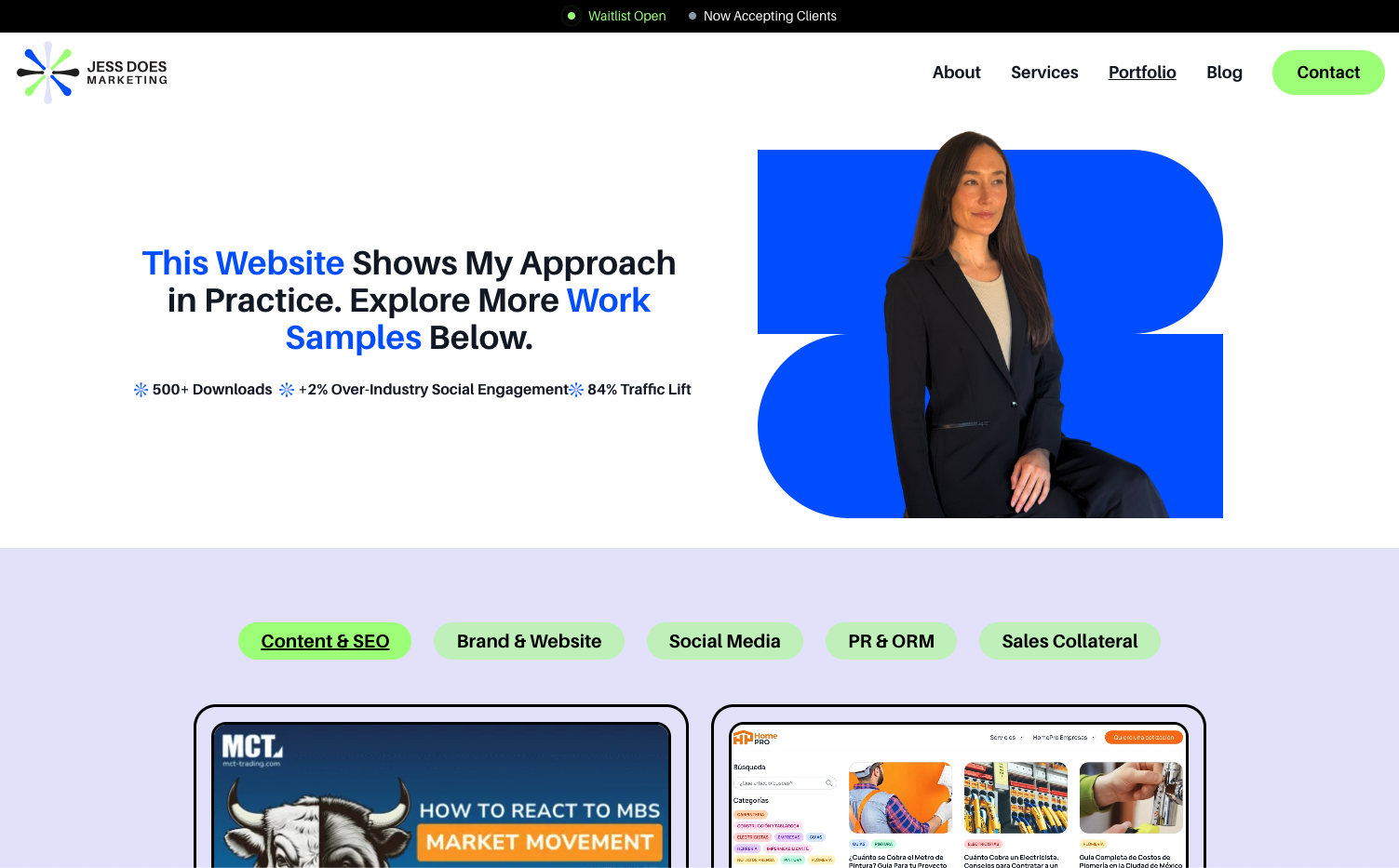
Here’s a real example of what it looks like when it comes together. My own portfolio leads with three specific numbers in the hero:
- 500+ content downloads
- 84% traffic lift
- 2% above-industry social engagement
The work is organized by type (Content & SEO, Brand & Website, Social Media, PR & ORM, Sales Collateral), and each piece links to something live. You don’t have to dig for the work, and you don’t have to guess what kind of marketer I am. That’s the standard to aim for, even if you’re starting with two samples instead of twenty.
For the writing samples themselves, learning a structured editing process before you publish makes a real difference in quality. If you want something structured to work through before adding samples to your portfolio, start by editing existing work. Strong portfolio samples are edited samples.
What makes a portfolio fall flat is equally worth knowing. A portfolio that hasn’t been updated in two years, one that’s hard to navigate, or one that describes work without showing it are all common problems. If someone has to click three times to find your best sample, they probably won’t.
How to present your portfolio in a job interview
A lot of early-career marketers put together a portfolio and then forget to actually reference it during interviews. Don’t do that.
Before an interview, pick two or three specific portfolio pieces that are most relevant to the role. Be ready to walk through what the goal was, what you did, and what happened. Even if the outcome was modest, talking through your process shows that you think strategically.
If the interviewer hasn’t pulled up your portfolio by mid-interview, offer it. “I have a few examples of this kind of work in my portfolio, if you’d like to look at them” is a natural entry point.
For content marketing roles in particular, be prepared to talk about your editing process and how you make decisions about what to write. That’s often where junior candidates lose interviews, not because their samples are weak, but because they can’t explain their thinking.
How to use your marketing portfolio in your job search
Your portfolio is a tool, not a display case. Here’s how to put it to work.
Link it from the top of your resume. Put the URL next to your name, not buried in a summary section. Hiring managers skim resumes fast. Make the portfolio easy to find.
Add it to your LinkedIn profile. The “Featured” section lets you display portfolio links and specific pieces directly on your profile. Use it.
Reference it specifically in cover letters. Don’t just say “please see my portfolio.” Point to one piece that’s relevant to the role. “I’ve included a content audit I ran for a local restaurant that I think reflects the kind of work you’re describing” is more useful than a generic link.
Send it proactively in cold outreach. If you’re reaching out to potential clients or employers without an active job posting, your portfolio is what makes that outreach feel substantive instead of random. “Here’s some of the work I’ve done” is a better introduction than a resume alone.
Learning how to become a marketer is your first real test of your marketing chops. To become a marketer, you have to be able to market yourself properly.
Start before you’re ready
Building a marketing portfolio isn’t a complicated project. Start with what you have. Make more things. Put them somewhere online. Keep adding as you learn.
The marketers who break in aren’t always the ones with the most experience. They’re the ones who made it easy for someone to say yes.
If you want practical guides like this one in your inbox regularly, subscribe to the Marketer’s Desk newsletter below.
Some of the links in this post are affiliate links, which means I may earn a small commission if you sign up through them, at no extra cost to you. I only recommend tools I’d actually point a new marketer toward.
Enjoyed this? Get more like it.
Marketing strategy and resources in your inbox. Free, always.